What I mind, when the temperature is, as it is now, a hair below 0F (minus 18 C) is what I have to do in order to walk the dogs. The long underwear and the two sweaters I'm wearing anyway. The gloves and the ski suit and the big green clompy boots. The facemask and the big warm Uigur hat... I look like an incompetent Jewish Ninja.

Even working, down in my gazebo, when the temperature drops like this, with all the heaters on, I'll still be wearing a battered down jacket and a huge Doctor Who style scarf...

When I moved out to this part of the world, about 18 years ago, I noticed an odd phenomenon. Friends who were from here, who loved it, who were part of the life and scene and soul of Minneapolis would just announce, out of nowhere, that they were leaving, and they were done now. And they'd sell up and Go South. They'd always Go South.
That's odd, I thought. They're so happy here.
It seemed a bit sinister.
Today, walking the dogs, I sort of got it. Suddenly the oncoming cold, the idea that every time I would need to walk the dogs for the next three, perhaps the next five months, during the daylight...

or at night...

...that I'm going to have to suit up like a spaceman on a planet inimical to human life. Every single time. And I'm going to get to the point where I look forward to the temperature getting up to 0F, because you can breathe without it hurting, and you don't have to put on crazy protection to go outside, and the dogs still enjoy it outside at this temperature.
I thought, I bet the Caribbean's really nice this time of year.
And I shivered, under the snow-suit, in a way that had nothing to do with the cold, and I thought, I bet that's what they all thought. The people who Went South.
I do not believe that I am joining them. Not yet. But I definitely understood them.
...
The FAQ line is backed up. I've got several hundred questions marked. Let us try and get a few answered:
My wife Kestrell (she of the Delerium eyes) and I are going to visit New Orleans in a few months. She wants to visit the hat shop where you got your birthday/wedding top hat. Could you tell me the name?
It was Fleur de Paris (http://www.fleurdeparis.net). Terrific hats, lovely people, and Holly got a beautiful dress there, too. Amanda also bought dresses and such at Trashy Diva, which is much classier than the name sounds.
My top hat (and many of the other hats people bought while there, until by the end it looked like some kind of hat convention) came from Meyer the Hatter - http://www.meyerthehatter.com/meyer/. I really liked them -- not just good service, but after buying my hat (which they padded slightly to fit me) I went back with friends, and Sam Meyer, the owner took my hat back and replaced it with one that fit me exactly, as they'd had a delivery that day, and it was a matter of pride to him that my hat fit properly.
...
I have found a post in your archives addressing whether or not college is a necessary pre-req for aspiring authors, but I wanted to ask something a bit deeper than that. During high school I was widely known for my writing. I was granted a number of rewards (although insignificant; it was high school after all) and was voted Most Intellectual out of my +650 person senior class with a C average.
I am currently an unsatisfied student at Middle Tennessee State University considering dropping out after this semester. In college I have found myself completely withdrawn from my love of writing and, perhaps far worse, that of reading. I've not finished reading a book in nearly two months, I haven't learned a word or written anything I felt I liked in just as long and I've been dropped from my Expository Writing class after my professor, who supposedly favored me, sent me an email about my truancy. I am nearly twenty years old, I've never been published, I can't find a job and after seeing what it means to be a college professor, I no longer want to be that.
Out of my considering leaving school, I've lost much. Many of my friends and family members (including my mother) and my former mentor (a Latin and Mythology teacher from H.S.) have practically shunned me from their lives. My girlfriend dumped me because of it (though honestly I'm not very upset, but it's relevant) and I'll possibly be kicked out of my house if I go through with my decision.
My salvation from this is, and always has been, a story I have spent most of five years working on that I've fallen in love with, and I am confident it will do well as long as it is that love that continues to facilitate its manifestation.
I'm well-aware life will be more difficult without a degree, and I know you mentioned "if an editor likes page one, they will turn to page two" degree or not, but my question is. . .
Given those circumstances, would this decision be a wise one? Am I the lazy, presumptuous child who thinks he knows best? Or a misunderstood author walking his own path? Or even better, someone who knows he can sing his song with a voice (or pen) that will do it justice? (I've been re-reading Anansi Boys)
I've asked my professors; they remain objective to my situation. Since you're always kind enough to answer questions on this blog, and do the same to those who ask you questions in person, and because much of what I write involves using gods and mythology as metaphor, I thought I should ask you. I know full well you haven't all the answers, but I would be forever grateful for your opinion.
Regardless of whether you answer or not, you have my thanks for your time and I look forward to seeing American Gods on the silver screen.
-Levi
Should you drop out, or delay university? It sounds like you've already made your decision.
I find the idea of a writer losing interest in both writing and reading really sad. And beyond that, I think two things. One is that, as you say (and I've pointed out in the past) nobody's going to ask for your qualifications before they read your book.
I have found a post in your archives addressing whether or not college is a necessary pre-req for aspiring authors, but I wanted to ask something a bit deeper than that. During high school I was widely known for my writing. I was granted a number of rewards (although insignificant; it was high school after all) and was voted Most Intellectual out of my +650 person senior class with a C average.
I am currently an unsatisfied student at Middle Tennessee State University considering dropping out after this semester. In college I have found myself completely withdrawn from my love of writing and, perhaps far worse, that of reading. I've not finished reading a book in nearly two months, I haven't learned a word or written anything I felt I liked in just as long and I've been dropped from my Expository Writing class after my professor, who supposedly favored me, sent me an email about my truancy. I am nearly twenty years old, I've never been published, I can't find a job and after seeing what it means to be a college professor, I no longer want to be that.
Out of my considering leaving school, I've lost much. Many of my friends and family members (including my mother) and my former mentor (a Latin and Mythology teacher from H.S.) have practically shunned me from their lives. My girlfriend dumped me because of it (though honestly I'm not very upset, but it's relevant) and I'll possibly be kicked out of my house if I go through with my decision.
My salvation from this is, and always has been, a story I have spent most of five years working on that I've fallen in love with, and I am confident it will do well as long as it is that love that continues to facilitate its manifestation.
I'm well-aware life will be more difficult without a degree, and I know you mentioned "if an editor likes page one, they will turn to page two" degree or not, but my question is. . .
Given those circumstances, would this decision be a wise one? Am I the lazy, presumptuous child who thinks he knows best? Or a misunderstood author walking his own path? Or even better, someone who knows he can sing his song with a voice (or pen) that will do it justice? (I've been re-reading Anansi Boys)
I've asked my professors; they remain objective to my situation. Since you're always kind enough to answer questions on this blog, and do the same to those who ask you questions in person, and because much of what I write involves using gods and mythology as metaphor, I thought I should ask you. I know full well you haven't all the answers, but I would be forever grateful for your opinion.
Regardless of whether you answer or not, you have my thanks for your time and I look forward to seeing American Gods on the silver screen.
-Levi
Should you drop out, or delay university? It sounds like you've already made your decision.
I find the idea of a writer losing interest in both writing and reading really sad. And beyond that, I think two things. One is that, as you say (and I've pointed out in the past) nobody's going to ask for your qualifications before they read your book.
Maybe you should do other things, or study other things, for a while. Go and be a journalist, or work your way around the world. Accumulate experiences that one day you'll write about. (There are few 20 year olds I'd advise to drop everything and become novelists.)
The other is that I'm glad this letter came in a couple of days after yours. It is, as Diane says, long. It's also fascinating.
Hi, Neil,
I’m sorry that this is going to be long, but it’s something that I’ve been thinking about for a long time.
From time to time you get letters from young writers wondering if they should go to college to study creative writing. You give them good advice about what it really takes to become a writer, but offer the caveat that, since you didn’t study creative writing, you can’t really tell them what a creative writing program will offer them. I’d like to offer my two cents and 20+ years of experience. I got my BA in creative writing in 1987 and just finished up an MFA in fiction this past year. I’m currently a teaching assistant for the class all undergrad writing majors have to take in order to graduate with a degree in creative writing.
First off, a lot of the instructors teaching creative writing in colleges and universities are doing so because they cannot support themselves as writers in any other way. Poets almost universally need to teach in order to practice their craft because there are no paying markets for poetry anymore. But a lot of other writers/professors in fiction are there because their work will not have a wide-spread audience. There are exceptions – Zadie Smith and Jane Smiley are two notable ones. Writing programs can sometimes attract established (ie; financially viable) writers to teach for a semester or two, but keeping them on as tenured (permanent) faculty is difficult because of the demands of teaching classes, reading applications, sitting on review panels, etc. It takes seven years to become a tenured faculty member. One of my own professors has just left teaching at the university because she signed a six-figure deal for her first novel. I don’t expect her to come back because
she doesn’t need to at this point, even though she is a phenomenal professor and liked teaching.
So, you have a teaching staff interested, above all, in the artistic integrity of the work they are producing. This is what they know, this is what they teach. One of the primary products of a creative writing program is not financially viable writers but creative writing teachers – for elementary and high schools, community colleges, and universities. There are exceptions! Lots of writers who graduate from Iowa and Texas or the Stegner Fellowship at Stanford and other revered programs (but usually the graduate programs, not the undergraduate ones) can use these credentials as selling points when they are looking for agents and publishers. The rest of us don't get a lot of street cred for having gone to school for creative writing and an undergrad degree doesn't get you very far because most don't require you to be accepted into a program of study. You take the classes, you get the degree, regardless of the quality of your work.
You can expect to learn a lot about craft in a creative writing program – how to develop characters, work on elements of narration, and, possibly, get some good feedback from other writers about your work. The dominant model for a writing program is the workshop where you distribute your story to everyone in your class, they read it, and come back the next week to critique it. Depending on the professor, this can be a valuable experience or it can be devastating. If you get class members who want to destroy any writer they see as competition for the title of “best in class,” the workshop can be quite destructive to a young writer who is just beginning to develop a sense of him or herself. Regardless of whether it’s a good workshop or not, you will be in a class with a lot of other writers who want to create ART and will scoff at anything that doesn’t have literary aspirations.
Creative writing programs will not teach you how to be a published writer. Talking about the business aspects of writing seems to be taboo in most programs. You will not learn how to assess writers’ guidelines, find publications that are looking for what you write, find an agent or, in anyway, make money from your writing. Though most writers do not make a living by writing, creative writing programs don't see themselves as needing to teach job skills. I think it’s because of this taboo most creative writing programs have a very strong bias against genre writing. Science fiction, fantasy, historical, romance, young adult (although there are starting to be programs specifically geared toward YA now) any writing you would not find in the “literature” section of the bookstore will be actively discouraged and, in some cases, forbidden in your classes.
I don’t understand the bias because there are so many fabulous “genre” stories that have become part of the literary canon – Brave New World, 1984, 100 Years of Solitude, just about anything written by Ursula LeGuin. Your work, too, Neil, is rapidly becoming part of the canon, as well. So I’m not sure why the bias exists in creative writing programs. There are exceptions, programs that support writers no matter what they write, but you have to search for them and ask the question, "Do you accept genre writing in your classes?"
As a young writer, I wrote a lot of science fiction and fantasy. I wrote a 200+ page fantasy novel when I was 13, and submitted stories to Asimov’s and other magazines before I stepped foot on a college campus. I had no question that I was going to study creative writing when I went to school, but, in my very first class, my professor laid down the law. She only wanted straight, literary fiction, no genre at all. This bias continued throughout my undergrad program, and, I think, resulted in my losing myself as a writer for several years after graduation. I had lost what I wanted to write and didn’t want to write what my professors had been looking for and praising.
I’m writing this because of an experience I’ve had with a professor for the past couple of months. I finished my MFA in fiction in May, but am a teaching assistant for an undergrad class for the fall semester. One of the students in the class has been writing a fantasy novel – quite good, in my opinion. About half-way through the semester, the professor started talking to the TA’s about “didn’t I say no genre in this class?” and how awful this student’s writing is. Myself and another TA have defended his work. We like it a lot. Last night, in our pre-class meeting, this professor told us she was thinking about having the students sign a contract at our last class meeting pledging not to write genre. One of her reasons: they’re too young to be writing genre. My internal response was: ‘Too young? Neil Gaiman was writing the Sandman stories in his 20’s and changed an entire industry. How are these students ‘too young’ to be writing genre?’ I talked to
this student after class, writer to writer, and told him, if she does this, to ignore her and not to take it to heart, no one has the right to tell a writer what to write.
I’m writing this because of the questions you get from young writers looking for advice about creative writing programs, and want to say, this is the kind of bias you will find in creative writing programs. If you can tuck your fantasy story away, work on it for yourself, and write realistic fiction for your classes, great, head to college for a degree in creative writing. It will be difficult for you to get any positive feedback on your work from your professors and your classmates, recognizing the way the wind blows, will soon hop on the critical bandwagon. In my experience, if you are looking for help to become a better writer, especially for genre fiction, the best thing you can do for yourself is to read a lot and write a lot. If you still want outside help, find writing workshops or a writers’ group and go to conferences and attend sessions by writers who talk about their craft. Save the college degree for an area that interests you, like history or psychology, that
will feed your writing with material you can use.
Thanks for listening,
Diane Glazman
Thank you for writing, and so exhaustively.
I think that if you want to write SF or Fantasy, you could do a hell of a lot worse than apply for Clarion. (http://clarionfoundation.wordpress.com/). I taught there a few years ago, and John Scalzi, who will be one of the instructors this year writes about it at http://whatever.scalzi.com/2010/12/02/clarion-submission-period-open/. Kat Howard, who was in my Clarion Year, blogged about it at http://strangeink.blogspot.com/2010/12/most-wonderful-time-of-year.html and if anyone's interested, they should read her blog.
The other is that I'm glad this letter came in a couple of days after yours. It is, as Diane says, long. It's also fascinating.
Hi, Neil,
I’m sorry that this is going to be long, but it’s something that I’ve been thinking about for a long time.
From time to time you get letters from young writers wondering if they should go to college to study creative writing. You give them good advice about what it really takes to become a writer, but offer the caveat that, since you didn’t study creative writing, you can’t really tell them what a creative writing program will offer them. I’d like to offer my two cents and 20+ years of experience. I got my BA in creative writing in 1987 and just finished up an MFA in fiction this past year. I’m currently a teaching assistant for the class all undergrad writing majors have to take in order to graduate with a degree in creative writing.
First off, a lot of the instructors teaching creative writing in colleges and universities are doing so because they cannot support themselves as writers in any other way. Poets almost universally need to teach in order to practice their craft because there are no paying markets for poetry anymore. But a lot of other writers/professors in fiction are there because their work will not have a wide-spread audience. There are exceptions – Zadie Smith and Jane Smiley are two notable ones. Writing programs can sometimes attract established (ie; financially viable) writers to teach for a semester or two, but keeping them on as tenured (permanent) faculty is difficult because of the demands of teaching classes, reading applications, sitting on review panels, etc. It takes seven years to become a tenured faculty member. One of my own professors has just left teaching at the university because she signed a six-figure deal for her first novel. I don’t expect her to come back because
she doesn’t need to at this point, even though she is a phenomenal professor and liked teaching.
So, you have a teaching staff interested, above all, in the artistic integrity of the work they are producing. This is what they know, this is what they teach. One of the primary products of a creative writing program is not financially viable writers but creative writing teachers – for elementary and high schools, community colleges, and universities. There are exceptions! Lots of writers who graduate from Iowa and Texas or the Stegner Fellowship at Stanford and other revered programs (but usually the graduate programs, not the undergraduate ones) can use these credentials as selling points when they are looking for agents and publishers. The rest of us don't get a lot of street cred for having gone to school for creative writing and an undergrad degree doesn't get you very far because most don't require you to be accepted into a program of study. You take the classes, you get the degree, regardless of the quality of your work.
You can expect to learn a lot about craft in a creative writing program – how to develop characters, work on elements of narration, and, possibly, get some good feedback from other writers about your work. The dominant model for a writing program is the workshop where you distribute your story to everyone in your class, they read it, and come back the next week to critique it. Depending on the professor, this can be a valuable experience or it can be devastating. If you get class members who want to destroy any writer they see as competition for the title of “best in class,” the workshop can be quite destructive to a young writer who is just beginning to develop a sense of him or herself. Regardless of whether it’s a good workshop or not, you will be in a class with a lot of other writers who want to create ART and will scoff at anything that doesn’t have literary aspirations.
Creative writing programs will not teach you how to be a published writer. Talking about the business aspects of writing seems to be taboo in most programs. You will not learn how to assess writers’ guidelines, find publications that are looking for what you write, find an agent or, in anyway, make money from your writing. Though most writers do not make a living by writing, creative writing programs don't see themselves as needing to teach job skills. I think it’s because of this taboo most creative writing programs have a very strong bias against genre writing. Science fiction, fantasy, historical, romance, young adult (although there are starting to be programs specifically geared toward YA now) any writing you would not find in the “literature” section of the bookstore will be actively discouraged and, in some cases, forbidden in your classes.
I don’t understand the bias because there are so many fabulous “genre” stories that have become part of the literary canon – Brave New World, 1984, 100 Years of Solitude, just about anything written by Ursula LeGuin. Your work, too, Neil, is rapidly becoming part of the canon, as well. So I’m not sure why the bias exists in creative writing programs. There are exceptions, programs that support writers no matter what they write, but you have to search for them and ask the question, "Do you accept genre writing in your classes?"
As a young writer, I wrote a lot of science fiction and fantasy. I wrote a 200+ page fantasy novel when I was 13, and submitted stories to Asimov’s and other magazines before I stepped foot on a college campus. I had no question that I was going to study creative writing when I went to school, but, in my very first class, my professor laid down the law. She only wanted straight, literary fiction, no genre at all. This bias continued throughout my undergrad program, and, I think, resulted in my losing myself as a writer for several years after graduation. I had lost what I wanted to write and didn’t want to write what my professors had been looking for and praising.
I’m writing this because of an experience I’ve had with a professor for the past couple of months. I finished my MFA in fiction in May, but am a teaching assistant for an undergrad class for the fall semester. One of the students in the class has been writing a fantasy novel – quite good, in my opinion. About half-way through the semester, the professor started talking to the TA’s about “didn’t I say no genre in this class?” and how awful this student’s writing is. Myself and another TA have defended his work. We like it a lot. Last night, in our pre-class meeting, this professor told us she was thinking about having the students sign a contract at our last class meeting pledging not to write genre. One of her reasons: they’re too young to be writing genre. My internal response was: ‘Too young? Neil Gaiman was writing the Sandman stories in his 20’s and changed an entire industry. How are these students ‘too young’ to be writing genre?’ I talked to
this student after class, writer to writer, and told him, if she does this, to ignore her and not to take it to heart, no one has the right to tell a writer what to write.
I’m writing this because of the questions you get from young writers looking for advice about creative writing programs, and want to say, this is the kind of bias you will find in creative writing programs. If you can tuck your fantasy story away, work on it for yourself, and write realistic fiction for your classes, great, head to college for a degree in creative writing. It will be difficult for you to get any positive feedback on your work from your professors and your classmates, recognizing the way the wind blows, will soon hop on the critical bandwagon. In my experience, if you are looking for help to become a better writer, especially for genre fiction, the best thing you can do for yourself is to read a lot and write a lot. If you still want outside help, find writing workshops or a writers’ group and go to conferences and attend sessions by writers who talk about their craft. Save the college degree for an area that interests you, like history or psychology, that
will feed your writing with material you can use.
Thanks for listening,
Diane Glazman
Thank you for writing, and so exhaustively.
I think that if you want to write SF or Fantasy, you could do a hell of a lot worse than apply for Clarion. (http://clarionfoundation.wordpress.com/). I taught there a few years ago, and John Scalzi, who will be one of the instructors this year writes about it at http://whatever.scalzi.com/2010/12/02/clarion-submission-period-open/. Kat Howard, who was in my Clarion Year, blogged about it at http://strangeink.blogspot.com/2010/12/most-wonderful-time-of-year.html and if anyone's interested, they should read her blog.
I've not taught at Clarion West - http://www.clarionwest.org/ - but the instructor line up this year is amazing.
And here's a terrific round-up of all the SF/Fantasy writers' boot-camps and courses and such: http://www.johnjosephadams.com/2007/10/article-basic-training-for-writers/
...
The power just went out. Came back. Went off, came back, went off. And then came back.
When the power goes off in warm places, people do not worry about freezing, do they?
...
I'll be talking about Comics on TALK OF THE NATION tomorrow. Well, later today.
The Kevin Smith Smodcastle interview is 2/3 up right now; The first part is at http://smodcast.bandcamp.com/track/chapter-1-the-neil-amanda-interview
(That's the interview).
The second part, Amanda songs, is up at http://smodcast.bandcamp.com/track/chapter-2-amanda-fucking-palmer-rocks
Any moment now, the last part will go up. That'll consist of me reading "Being an Experiment..." and enlisting Kevin and Amanda to help me read the Bilquis section of the first chapter of American Gods.
...
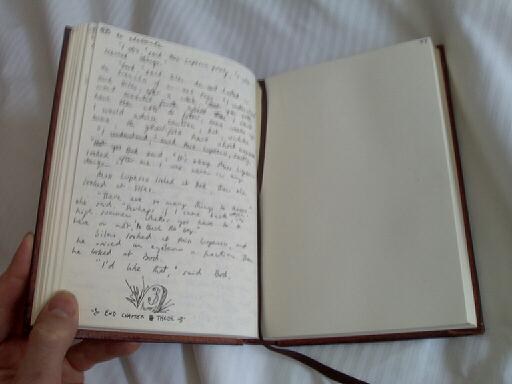
And finally, an article on Boing Boing about Cairo, not the one in Egypt but the one in Illinois, which has been on my mind a little recently from having been doing the Tenth Anniversary American Gods copy-editing. While I think Cory's description of it as a Ghost Town is exaggeration, things don't look good. And from this informative post I learned of the trouble people who wanted to start a punk coffee house there have had (it's now for sale).
Labels: cellphone photos, Clarion, cold [the extreme kind], dog photograph, universitying as a career, Winter, writing as a career