Journal

Showing posts with label Nebula Awards. Show all posts
Sunday, May 31, 2020

An Acceptance, in rough times

Last night, starting at at 1:00 in the morning, my time, was the Nebula Awards ceremony, held by the SFWA, the Science Fiction and Fantasy Writers of America. The first award they gave out was the Ray Bradbury Award for Outstanding Dramatic Presentation, and it meant the world that it went to episode 3 of Good Omens, "Hard Times".

Exactly one year ago, Good Omens was released to the world, on Amazon's Prime Video service. Thirty years ago this month, Good Omens was published as a novel. It seems amazing that it still has so much life, and still feels so relevant to people's own lives. Especially now.

Here's the complete list of all the nominees and of the awards given out at the Nebulas last night. Congratulations to everyone nominated!

The entire proceedings existed in virtual space, via the magic of Zoom and other technological things.
This is what it looked like on my screen, just before we went live...


Here is the speech I gave. I wore a hat, because, even though Terry Pratchett loved pointing out that he was a hat person and I wasn't, not really, I thought it would have amused him.

I didn't intend to write the television adaptation of Good Omens. I did it because as he knew his own immeasurable light was dimming, Terry Pratchett wrote to me, telling me I had to do it. That no-one else had the passion for the “old girl” that the two of us had. And I was the one of us who had to make it happen, so he could see it before the lights went out.

I'm used to dealing with the problems of fictional people.  Now I found myself dealing with much harder problems, of real people and immutable budgets.  But I was even more determined to make something Terry would have been proud of. And I was part of an amazing team – Douglas Mackinnon, our director, Rob Wilkins, Chris Sussman and Simon Winstone and the folk from BBC Studios, the Amazon Studios team, and above us all the cast and the crew, who united and went over and above what anyone asked of them to tell, together, a kind of love story about protecting the world, about an angel who isn't as angelic as he ought to be, and a demon who likes people. And for them, I want to thank Michael Sheen and David Tennant.

Terry and I had written a book about averting the end of the world, about the power of not going to war, about an armageddon that didn't have to happen.

When I was a boy, I was told that there was a curse, “May you live in interesting times”. And that made me sad, because I wanted to live in interesting times. I thought I did.

And now, we are all of us living in Interesting Times. The Horsepeople are riding out, as they have ridden so many times before, and the world still needs saving – from plague, from racism, from foolishness and selfishness and pain. It says in Good Omens that we have to save ourselves, because nobody else is going to sort it out for us. And we do. 

It feels almost indecent to be accepting an award while so many people are hurting, but thank you, from me and from Douglas, who took the words and made them so brilliantly come to life. This is for Terry Pratchett.

You can watch the whole ceremony at: 


or at this YouTube link:


(The Good Omens bit starts around 22:30)


Labels: , , ,

Monday, May 21, 2012

The unlikeliness of the long-distance golf-ball-headed chisel-wielder...

I've been thrilled how many people have watched and reblogged the commencement speech.

If you want to read it, there's a transcript up at the UArts website, here.

I went by train from Philadelphia to Arlington, where SFWA was holding the Nebula Awards weekend. I wasn't actually nominated for a Nebula: I was nominated, along with director Richard Clark, for a Ray Bradbury Award for the Doctor Who episode "The Doctor's Wife".

(I'd been nominated once before, in 1998, for writing the English language script to Princess Mononoke. And I lost.)

I hoped I had a chance, but didn't think it was a shoe-in: all the other things nominated were major Hollywood movies, including Midnight In Paris and Source Code. But I thought, seeing I was in the area,  and that I had lots of friends I would see who would commiserate if I lost, and forgive me if I won, that it might be a fun trip.

I went. It was a wonderful ceremony. Connie Willis was made a Grand Master, and I kvelled.

The Bradbury Award is unique: a man dressed as a diver with an old IBM selectric "golf ball" for a head, holding a mallet and chisel to carve the happy and sad faces of drama out of a pyramid on top of a book. There's nothing like it.

And yes, Richard and I (and Doctor Who) won. I thanked everybody, Richard, the amazing cast and crew, Steven Moffat, and then I thanked Verity Lambert and Sydney Newman, who put a cranky old time-traveller into a police box almost half a century ago, and sent him off across time and space.

Here is a photograph of me and John Scalzi dueling with Bradbury Awards:


I flew home this morning. I put the award above the desk beside my Jim Henson Creativity award, and surrounded it with poppets...


Labels: ,

Monday, February 20, 2012

One morning with Nebula Nominations

I started feeling last night that real work was happening. I could see it starting to mount. My morale is starting to improve, as it always does when writing happens, and I remember that I actually can do it after all.

Currently I'm mostly writing the HBO American Gods first episode. I'm really enjoying it, partly because a lot of what I've written isn't in the book. It's implied in the book, or talked about generally, or referred to obliquely, but it's scenes I hadn't written. So I feel that I'm doing new work, even if it's not new. If you see what I mean.

And, strangely, it seems to be feeding in to the next American Gods book, which is what I'm sort of working on right now. (Actually, I'm writing a short story that comes after Monarch of the Glen and before The Next Book. But it feels organically needed.) 

Other than that... I'm looking after myself. The main new thing I've been doing is actually jogging for 37 minutes a day. (It was 37 minutes the first day, and so I've kept it the same every other day to see how much further or faster I get, because my little iPod Nano keeps track of this stuff.)

I will do a proper catch-up blog post later in the week, I suspect. There's stuff I should write about that's been interesting or fun.

In the meantime, I was sent this press release last night. It had me doing a happy dance around the room, for my little bit of it. (Apart from anything else, it was wonderful seeing the other nominees in my category. Woody Allen! Duncan Jones!)

And, because they asked if I'd spread it around, I have cut and pasted the whole of the nomination list. (Congratulations to all the Nominees!)


2011
 Nebula Awards Nominees Announced


Science Fiction and Fantasy Writers of America is proud to announce the nominees for the 2011 Nebula Awards (presented 2012), the nominees for the Ray Bradbury Award for Outstanding Dramatic Presentation, and the nominees for the Andre Norton Award for Young Adult Science Fiction and Fantasy Book.

Novel
Among Others, Jo Walton (Tor)
Embassytown, China MiƩville (Macmillan UK; Del Rey; Subterranean Press)
Firebird, Jack McDevitt (Ace Books)
God's War, Kameron Hurley (Night Shade Books)
Mechanique: A Tale of the Circus Tresaulti, Genevieve Valentine (Prime Books)
The Kingdom of Gods, N.K. Jemisin (Orbit US; Orbit UK)

Novella
"Kiss Me Twice," Mary Robinette Kowal (Asimov's Science Fiction, June 2011)
"Silently and Very Fast," Catherynne M. Valente (WFSA Press; Clarkesworld Magazine, October 2011)
"The Ice Owl," Carolyn Ives Gilman (The Magazine of Fantasy and Science Fiction,November/December 2011)
"The Man Who Bridged the Mist," Kij Johnson (Asimov's Science Fiction, October/November 2011)
"The Man Who Ended History: A Documentary," Ken Liu (Panverse Three, Panverse Publishing)
"With Unclean Hands," Adam-Troy Castro (Analog Science Fiction and Fact, November 2011)

Novelette
"Fields of Gold," Rachel Swirsky (Eclipse 4, Night Shade Books)
"Ray of Light," Brad R. Torgersen (Analog Science Fiction and Fact, December 2011)
"Sauerkraut Station," Ferrett Steinmetz (Giganotosaurus, November 2011)
"Six Months, Three Days," Charlie Jane Anders (Tor.com, June 2011)
"The Migratory Pattern of Dancers," Katherine Sparrow (Giganotosaurus, July 2011)
"The Old Equations," Jake Kerr (Lightspeed Magazine, July 2011)
"What We Found," Geoff Ryman (The Magazine of Fantasy and Science Fiction, September/October 2011)

Short Story
"Her Husband's Hands," Adam-Troy Castro (Lightspeed Magazine, October 2011)
"Mama, We are Zhenya, Your Son," Tom Crosshill (Lightspeed Magazine, April 2011)
"Movement," Nancy Fulda (Asimov's Science Fiction, March 2011)
"Shipbirth," Aliette de Bodard (Asimov's Science Fiction, February 2011)  
"The Axiom of Choice," David W. Goldman (New Haven Review, Winter 2011)    
"The Cartographer Wasps and the Anarchist Bees," E. Lily Yu (Clarkesworld Magazine, April 2011)
"The Paper Menagerie," Ken Liu (The Magazine of Fantasy and Science Fiction, March/April 2011)

Ray Bradbury Award for Outstanding Dramatic Presentation
Attack the Block, Joe Cornish (writer/director) (Optimum Releasing; Screen Gems)
Captain America: The First Avenger, Christopher Markus, Stephen McFeely (writers), Joe Johnston (director) (Paramount)
Doctor Who: “The Doctor's Wife,” Neil Gaiman (writer), Richard Clark (director) (BBC Wales)
Hugo, John Logan (writer), Martin Scorsese (director) (Paramount)
Midnight in Paris, Woody Allen (writer/director) (Sony)
Source Code, Ben Ripley (writer), Duncan Jones (director) (Summit)
The Adjustment Bureau, George Nolfi (writer/director) (Universal)

Andre Norton Award for Young Adult Science Fiction and Fantasy Book
Akata Witch, Nnedi Okorafor (Viking Juvenile)
Chime, Franny Billingsley (Dial Books; Bloomsbury)
Daughter of Smoke and Bone, Laini Taylor (Little, Brown Books for Young Readers; Hodder &Stoughton)
Everybody Sees the Ants, A.S. King (Little, Brown Books for Young Readers)
The Boy at the End of the World, Greg van Eekhout (Bloomsbury Children’s Books)
The Freedom Maze, Delia Sherman (Big Mouth House)
The Girl of Fire and Thorns, Rae Carson (Greenwillow Books)
Ultraviolet, R.J. Anderson (Orchard Books; Carolrhoda Books)

The winners will be announced at SFWA's 47th Annual Nebula Awards Weekend, to be held Thursday through Sunday, May 17 to May 20, 2012 at the Hyatt Regency Crystal City in Arlington, Virginia, near Reagan National Airport. As announced earlier this year, Connie Willis will be the recipient of the 2011 Damon Knight Grand Master Award for her lifetime contributions and achievements in the field. Walter Jon Williams will preside as toastmaster, with Astronaut Michael Fincke as keynote speaker.

...

Hi Neil,

I'm assuming you're at least marginally familiar with altered books.

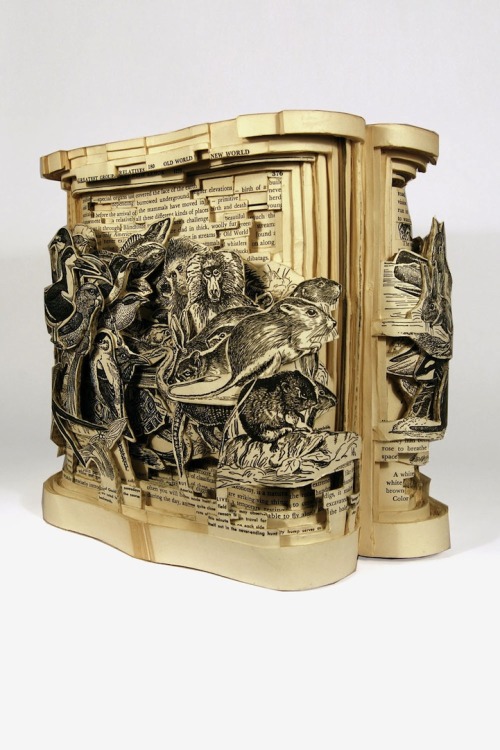
Someone linked to this in an art therapy forum I'm on, and I saw it and immediately thought of you. Specifically I was reminded of Mirrormask. I think it's a brilliant use of out of date reference books.

http://karanarora.posterous.com/insane-art-formed-by-carving-books-with-surgi

Enjoy!


I did.

Labels: , ,

Monday, April 28, 2008

Woot.

Back from the ABC studios where I was interviewed for Triple J -- it'll be up as a podcast for those of you who were either asleep or not in Australia (which is most of you): http://www.abc.net.au/triplej/ is their website, and I'll put up a link when they send it to me.

I just discovered that Michael Chabon's Yiddish Policemen's Union won the Nebula as Best SF novel of the year. As Maddy would say, Woot!

Congratulations to everyone else who won -- the complete list of winners and nominees is here (and I'm thrilled that Guillermo got the script Nebula for Pan's Labyrinth, just as I'm sorry that Stephen Moffat didn't get it for Blink, and that Gene Wolfe didn't get it for Memorare -- which you can read at http://www.sfsite.com/fsf/fiction/gw01.htm, and which I really, really hope gets the Hugo) (Gene Wolfe has never won a Hugo award. I'm just saying.)

I'm slowly catching up with things I've promised people, one thing at a time. Todd Klein asked if I would do the signed Todd-lettered print after the Alan Moore one, and there was no way I could say no. Then I kept him waiting on tenterhooks until I had an idea, and then I made him tenterhook longer while I worked on it, but eventually I finished something called Before You Read This, which begins
Before you read this familiarise yourself
with the text. Note the position of the escape hatches,
the candles that will light in the event of a forced landing
to show you the way out. The author will make an announcement.
and goes on from there. I'm looking forward to seeing whether it works when read aloud. Todd's got the work-in-progress version of the print up at


Which I mention here as the first printing of the Alan Moore print sold out in three days. (You can get a second printing at http://kleinletters.com/BuyStuffTop.html).

Since you're travelling I'm willing to bet this message will get lost in the shuffle, but here goes.

So I'm reading the excellent "Lonely Werewolf Girl" which I'm loving, more than "Good Fairies of New York" I think, but I have a bone to pick. Once I started keeping track, I've counted six typos in the first 233 pages. Maybe this seems like a small number of typos but I find it five typos too many! Don't people get paid specifically to ensure that doesn't happen?! It's driving me bonkers...

Anyway, not meant to be any slight against this wonderful, whimsical, punk rock, wolfy book, but seriously; what's up with that?

-J.

Speaking as someone currently proofreading The Graveyard Book, who is only certain of one thing: that typos will lurk and creep and scuttle on the edges of the text and, despite my best efforts, jump out and wave furiously at everyone as soon as I'm done, all I can do is sympathise. But you know, the magic of the internet is that Martin Millar, author of both the above books, has his own blog. It's at http://martin-millar.blogspot.com/ and he has his own website at http://www.martinmillar.com/, where not only can you ask him what's up with the typos, but if you give him a list of them, he can pass them on to his publishers and then they won't be typos in the next edition. Such is the magic of the internet. (Also, you can buy signed books directly from the author at http://www.lonelywerewolfgirl.co.uk/. Which is very nice of him.)


...

Dear Mr. Gaiman,

These are some very simple questions: Do you ever listen to music when you work on something or does it distract you? Have you ever been influenced by a song or peice of music to write a scene?

And last but not least: What are you listening to these days?

Thank you much,

John

Yes, I often write with music on. It doesn't distract me. Anything that makes me more comfortable and keeps me writing is good. And occasionally I'll reread something I've written and know what I was listening to when I wrote it. (I think it's a good bet that Iggy Pop's song Passenger was on repeat a lot when I wrote Sandman 5, for example.) As for what I'm listening to these days, It's mostly up at http://www.last.fm/user/neilhimself/. Here are a couple of Last.fm widgets that might or might not work -- one of songs that seem to have been played more than other songs in the last month, and the other the Last.Fm "My Radio Station", of songs it knows I enjoy...


Labels: , , , , ,

Saturday, April 30, 2005

The Speech I Just Gave at the Nebulas

Welcome, to the Nebula Awards, on this, the 40th anniversary of the founding of the SFWA. That's the Ruby Anniversary, for anyone wondering what sort of gift to give.

And forty years is a very short time in the life of a genre.

I suspect that if I had been given the opportunity to address a convocation of the most eminent writers of science fiction and fantasy when I was a young man -- say around the age of 23 or 24, when I was bumptious and self-assured and a monstrous clever fellow -- I would have a really impressive sort of speech prepared. It would have been impassioned and heart-felt. An attack on the bastions of science fiction, calling for the tearing down of a number of metaphorical walls and the building up of several more. It would have been a plea for quality in all ways - the finest of fine writing mixed with the reinvention of SF and Fantasy as genres. All sorts of wise things would have been said.

And now I'm occupying the awkward zone that one finds oneself in between receiving one's first lifetime achievement award and death, and I realise that I have much less to say than I did when I was young.

Gene Wolfe pointed out to me, five years ago, when I proudly told him, at the end of the first draft of American Gods, that I thought I'd figured out how to write a novel, that you never learn how to write a novel. You merely learn how to write the novel you're on. He's right, of course. The paradox is that by the time you've figured out how to do it, you've done it. And the next one, if it's going to satisfy the urge to create something new, is probably going to be so different that you may as well be starting from scratch, with the alphabet.

At least in my case, it feels as I begin the next novel knowing less than I did the last time.

So. A ruby anniversary. Forty years ago, in 1965, the first Nebula Awards were handed out. I thought it might be interesting to remind you all of the books that were Nominees for Best Novel in 1965...

All Flesh is Grass by Clifford D. Simak

The Clone by Theodore Thomas & Kate Wilhelm

Dr. Bloodmoney by Philip K. Dick

Dune by Frank Herbert

The Escape Orbit by James White

The Genocides by Thomas M. Disch

Nova Express by William Burroughs

A Plague of Demons by Keith Laumer

Rogue Dragon by Avram Davidson

The Ship That Sailed the Time Stream by G. C. Edmonson

The Star Fox by Poul Anderson

The Three Stigmata of Palmer Eldritch by Philip K. Dick


I love that list. It has so much going on -- SF and Fantasy of all shapes and sizes, jostling side by side. Traditional and iconoclastic fictions, all up for the same lucite block.

And if you're wondering, the 1965 Nebula Winners were,

Novel: Dune by Frank Herbert

Novella: "He Who Shapes" by Roger Zelazny and "The Saliva Tree" by Brian Aldiss (tie)

Novelette: "The Doors of His Face, the Lamps of His Mouth" by Roger Zelazny

Short Story: "'Repent, Harlequin!' Said the Ticktockman" by Harlan Ellison

... it was a good year.

Forty years on and we're now living in a world in which SF has become a default mode. In which the tropes of SF have spread into the world. Fantasy in its many forms has become a staple of the media. And we, as the people who were here first, who built this city on pulp and daydreams and four-colour comics, are coming to terms with a world in which we find several things they didn't have to worry about in 1965.

For a start, today's contemporary fiction is yesterday's near-future SF. Only slightly weirder and with no obligation to be in any way convincing or consistent.

It used to be easy to recognise SF written by mainstream authors. The authors always seemed convinced that this was the first novel to tackle Faster Than Light travel, or downloadable intelligence, or time paradoxes or whatever. The books were clunky and proud of themselves and they reinvented the wheel and did it very badly, with no awareness of the body of SF that preceded them.

That's no longer true. Nowadays things that were the most outlandish topics of SF are simply building blocks for stories, and they aren't necessarily ours. Our worlds have moved from being part of the landscape of the imagination to being part of the wallpaper.

There was a battle for the minds of the world, and we appear to have won it, and now we need to figure out what we're doing next.

I always liked the idea that SF stood for Speculative Fiction, mostly because it seemed to cover everything, and include the attitude that what we were doing involved speculation. SF was about thinking, about inquiring, about making things up.

The challenge now is to go forward and to keep going forward: to tell stories that have weight and meaning. It's saying things that mean things, and using the literature of the imagination to do it.

And that's something that each of us, and the writers who will come afterwards, are going to have to struggle with, to reinvent and make SF say what we need it to say.

Anyway.

Something that, after half a lifetime in this field and a lifetime as a reader, that I think worth mentioning and reminding people of, is that we are a community.

More than any field in which I've been involved, the people in the worlds of SF have a willingness to help each other, to help those who are starting out.

When I was 22, half a lifetime ago, I went to a Brian Aldiss signing at London's Forbidden Planet. After the signing, at the pub next door, I sat next to a dark, vaguely elfin gentleman named Colin Greenland who seemed to know a lot about the field and who, when I mentioned that I had written a handful of stories, asked to see them. I sent them to him, and he suggested a magazine that he'd done some work for that might publish it. I wrote to that magazine, cut the story down until it met their wordcount requirements, and they published it.

That short story being published meant more to me at the time than anything had up to that point, and was more glorious than most of the things that have happened since. (And Colin and I have stayed friends. About ten years ago, he sent me, without the author's knowledge, a short story by someone he'd met at a workshop named Susanna Clarke... but that's another story.)

So. Twenty two years ago.... Six months later I was in the process of researching my first genre book . It was a book of SF and Fantasy quotations, mostly the awful ones, called Ghastly Beyond Belief. [And here I wandered off into an extempore bit of quoting from Ghastly Beyond Belief, by me and Kim Newman, mostly about giant crabs. And space crabs too. I'm not going to try and reproduce it here, sorry.]

-- and I found myself astonished and delighted by the response within the field. Fans and authors suggested choice works by authors they loved or didn't. I remember the joy of getting a postcard from Isaac Asimov telling me that he couldn't tell the good from the bad in his works, and giving me blanket permission to quote anything of his I wanted to.

I felt that I'd learned a real lesson back then, and it's one that continues to this day.

What I saw was that the people who make up SF, with all its feuds -- the roots of most of which are, like all family feuds, literally, inexplicable --are still a family, and fundamentally supportive, and particularly supportive to the young and foolish.

We're here tonight because we love the field.

The Nebulas are a way of applauding our own. They matter because we say they matter, and they matter because we care.

They are something to which we can aspire. They are our way -- the genre's way, the way of the community of writers -- of thanking those who produced sterling work, those who have added to the body of SF, of Fantasy, of Speculative Fiction.

The Nebulas are a tradition, but that's not why they're important.

The Nebulas Awards are important because they allow the people who dream, who speculate, who imagine, to take pride in the achievements of the family of SF. They're important because these lucite blocks celebrate the ways that we, who create futures for a living, are creating our own future.

Labels: , ,

Sunday, April 29, 2001

American Gods Blog, Post 40

So here's the speech I made tonight, introducing the Nebula Awards. This was the text I went from, and I sort of smoothed it up as I went. 'Black Pudding' was changed to 'blood sausage' because few people knew what a black pudding was. [Note -- the 'Harper Collins Royalty Statements' is just a cheap laugh line, and not intended as a slur or commentary in any way on Harper Collins royalty statements; and anyway, I have been assured that Simon and Schuster's royalty statements are worse.]

And as soon as Avalon is done then I'll write about American Gods again. Maybe even... well, we'll see.

..........................................................................................................................................................
It occurred to me recently that if I were now to meet myself at the age of 12 – the age, as all of you here know well, that has been called the Golden Age of Science Fiction – I would, I have no doubt, be an extreme disappointment to my twelve year old self.

He might be impressed by the fact that I’m a writer – but then, he knew he was going to be a writer. That I’m that one of a relatively rare clan, a writer who makes his living writing, would make no difference to my 12 year old self. He is, after all, convinced that the simple action of writing a short story and getting it published is like winning the grand prize at the end of the Quiz Show: the roof opens up and goods and money tumble down. He also has a strong suspicion that supermarkets, bank managers, and car lots will, on production of a book with an author’s name on the spine, allow the author the pick of the best of what they have, and never charge him a penny.

(My 12 year old self has not met any authors.)

As I said, he knows he wants to be a writer. And, with a 12 year old arrogance that is utter and absolute, he knows what kind of an author he wants to be. He wants to be the kind of author who wins Nebula Awards.

Which is to say he wants to grow up to be an SF writer, and an SF writer of a particular kind. He wants to grow up to write the kind of SF that changes how people see the world. He knows there’s a difference between the Hugos and the Nebulas, and he likes the way that some books have won both of them. He wants to be a Delany, or a Zelazny or an Ellison. He wouldn’t mind being a Heinlein or a Niven or a LeGuin. He wants to write SF.

And I would have disappointed him. I didn’t grow up to be an SF writer, except possibly in the loosest most “SF doesn;t stand for science fiction, it stands for anything we damn well please” sense of the word.

Understand, this came as an enormous surprise to me. My first book was a collection of SF quotes, after all. (I wrote it with Kim Newman, it was called GHASTLY BEYOND BELIEF, and it contained a raft of quotes from SF books and movies. My favourite was from Guy N Smith’s seminal giant crabs novel NIGHT OF THE CRABS “He wasn’t going to leave her alone that night, crabs or no crabs”.)

I was sure I was going to be an SF writer, as sure as anyone can be of anything. I just didn’t turn out that way.

Most writers of fiction are autodidacts, to some degree or another. We learn to teach ourselves what we need. We get in there fast and shallow and we suck the life and the juice from the subject in our own way. Then we manage to give the impression that we know everything about the subject in our writing.

I feel sorry for all the teachers who attempted to teach me the rudiments of subjects that I had no interest in. If I’d known that I’d need history and geography to write with, I would have studied much harder, just as I would have paid more attention in Maths if I’d known that one day I was going to have to make sense of Harper Collins royalty statements.

The subject I paid most attention to in school was SF. That they didn’t teach it made no difference. It was what I was studying. I was reading all the SF that was published and available, and, having finished that, I was reading everything I could find that was out of print, dusty, forgotten.

I enjoyed the good books, and I enjoyed the bad books. I read everything.

But most of all I looked out for and hunted down and read things that had won the Nebula. Because I knew it was going to be good. Not just popular good, but well-written, and wise, and that it would stretch my head into places it had not been before.

I am almost 30 years older than that boy, and I have become both more blase and more cynical about awards. I’ve won more than my share of awards. I’ve been an awards judge, and have learned that awards judges, like the makers of black pudding, do their business behind closed doors for a reason. I’ve learned that popular and democratic awards are too often fickle, and easily manipulated, and no guarantee of lasting worth.

Still, as individuals and as a group, the Nebulas are wonderful things. It’s a fine thing to be nominated for an award. It’s a finer thing to win an award – at least until the next morning, when you have to face a blank sheet of paper, and you find the writing no easier than it ever was – and, often, it’s harder.

But the real importance of awards like the Nebula, I like to think, is in telling us, and, more importantly, telling the next generations of SF writers, where to look, where to go, where the best writing and the coolest ideas are to be found. And this, after all, is what we are here for tonight.

Labels: , , ,

Friday, April 27, 2001

American Gods Blog, Post 38

Went to England for four days. Heard some wonderful music. Came back. Spent a day at home (a whole day!) and then flew to LA where I am to be Master of Ceremonies at the Nebula Award banquet Saturday night.

I’ll be doing a signing Saturday 28th of April (tomorrow, or later today, depending on when you read this) (unless you read this after Saturday, of course), at the LA book fair at UCLA at 1:00pm, at the Dangerous Visions/SFWA area. Come and say hullo if you’re in the area.

Lots of interesting things happening – the permissions were all gathered in in a manic last-minute flurry which owed an awful lot to Kelly Notaras at Harper Collins US; the Canadian signings seem to have edged earlier and the UK signings have continued later and I’m not sure at this point I get a single day off (excluding transatlantic travel days) between June 18th and July 20th; I may be doing a reading in tandem with a Magnetic Fields concert in June in New York; various interesting media things happening – lots of magazines and periodicals doing reviews and features on the book.

And I am not writing about any of these things because, with the writers strike looming, I am madly trying to finish writing some additional material for a very cool Polish/Japanese film called AVALON, so am spending all my time in my hotel room playing and replaying the video of the film and making notes and writing bits.

The best bit about the writer’s strike is a bunch of contracts that have been being negotiated with various studios' business affairs departments for the last 18-months-to-a- year were messengered over to my hotel today, and I sat and signed, and signed, and signed. Obviously a strike, like a hanging, concentrates the mind wonderfully.

Labels: , , , , ,

Thursday, March 08, 2001

American Gods Blog, Post 18

Hey. I'm nominated for a Nebula, for best screenplay. Isn't that fun?

http://www.sfwa.org/awards/

(I'm not sure that my part in Mononoke was screenplay-worthy, and if it did get it, Jack Fletcher, the English language voice director, deserves as much of it as I do. But still, it's always fun to be nominated for things.)

Labels: , , ,